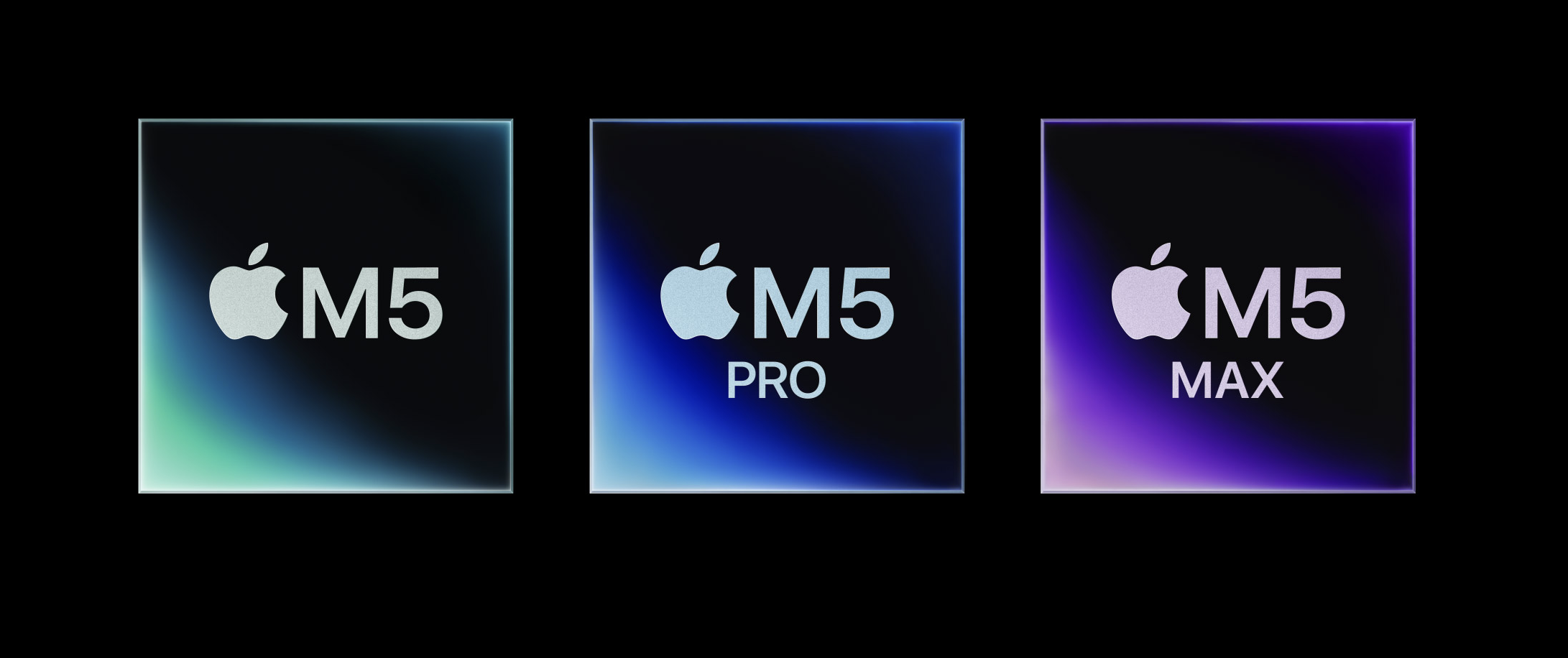
With the widespread rollout of the M5 chip, Apple’s MacBook lineup has received a fresh update. The currently available M5 models span the full range of sizes—13, 14, 15, and 16 inches—across the MacBook Air and MacBook Pro series, catering to a broad spectrum of needs, from lightweight office tasks to professional-grade creative work. This guide breaks down the core differences between each model to help you find the perfect fit and avoid overspending.
I. MacBook Air Series: 13-inch / 15-inch (M5 Standard)
The Air series prioritizes extreme portability and long battery life, making it the top choice for mobile professionals, students, and casual users. The M5-powered lineup currently includes 13-inch and 15-inch models.
• 13-inch MacBook Air (M5): As the entry-level model, it weighs just 1.24kg and measures 11.3mm in thickness. Its fanless, silent design ensures virtually noiseless operation during daily use. Equipped with the standard M5 chip (10-core CPU + 8/10-core GPU)—delivering a performance boost of approximately 20% over the previous M4 generation—it starts with 16GB of RAM and 512GB of storage. With up to 18 hours of battery life, it is well-suited for document processing, online meetings, and light photo editing. It is an ideal choice for budget-conscious users who value portability; starting at 8,499 RMB (in the Chinese market), it is also poised to become a staple in the second-hand market for M5-based devices.
• 15-inch MacBook Air (M5): Positioned as a large-screen, lightweight laptop, it features a 15.3-inch Liquid Retina display—offering 30% more screen real estate than the 13-inch version. It is perfect for users who frequently work with spreadsheets, watch videos, or perform light video editing. Weighing 1.51kg—only 270g heavier than the 13-inch model—it maintains excellent portability. The specifications mirror those of the 13-inch model, featuring the same M5 chip and offering up to 18 hours of battery life. With a starting price of 9,999 RMB, it serves as an ideal compromise for users who want a larger screen without sacrificing portability.
Both Air models come equipped with dual Thunderbolt 4 ports, Wi-Fi 7, and a 12MP Center Stage camera. They are available in new color options, such as Sky Blue, while maintaining the signature minimalist aesthetic of the Air series. The only notable drawback is the lack of active cooling; under sustained, high-load tasks, the system may throttle performance, making these models less suitable for intensive creative work or gaming.
II. MacBook Pro Series: 14-inch/16-inch (M5/M5 Pro/M5 Max)
The Pro series focuses on professional-grade performance and expandability. It is available with M5, M5 Pro, or M5 Max chips, catering to a wide range of needs—from advanced office tasks to high-end professional creative work.
• 14-inch MacBook Pro (Standard M5): Released in October 2025, this is the entry-level model in the Pro series. It features the same M5 chip found in the Air, but includes an active cooling system, allowing for more stable performance that avoids thermal throttling during prolonged, high-load tasks. It boasts a mini-LED XDR display with a peak brightness of 1,600 nits and supports ProMotion adaptive refresh rates, offering color performance that far surpasses the Air series. With a comprehensive selection of ports—including HDMI, an SD card slot, and a MagSafe charging port—it offers excellent expandability. It provides up to 22 hours of battery life, making it well-suited for entry-level designers and video editors who need a balance of performance and portability. While its starting price is higher than an Air model with similar specifications, it offers exceptional value on the secondary (used) market. • MacBook Pro 14-inch (M5 Pro/Max): Updated in March 2026, this high-end model features the M5 Pro or M5 Max chip. The M5 Pro version offers up to an 18-core CPU and 20-core GPU with a maximum of 64GB of RAM, while the M5 Max version scales up to an 18-core CPU and 40-core GPU. With significantly increased memory bandwidth, it handles large project files, 3D modeling, and 8K video editing with ease. The thermal system has been further optimized to maintain high performance even during extended rendering sessions. It also supports Thunderbolt 5, doubling the efficiency when connecting to high-speed external storage—an ideal choice for professional creators and heavy multitaskers.
• MacBook Pro 16-inch (M5 Pro/Max): The current flagship of the M5 series, featuring a 16.2-inch mini-LED display with ProMotion adaptive refresh rate, offering top-tier visual clarity and color accuracy. The larger chassis provides superior thermal management, allowing the M5 Max chip to reach its full performance potential. It is a true "performance beast" for demanding creative workflows such as film and video post-production, 3D animation, and AI model training. It shares the same port configuration as the 14-inch model and offers up to 24 hours of battery life. It is perfect for users who work from a fixed station and require a large screen and maximum performance; it also remains a popular choice for professionals in the secondary (used) market.
III. Purchasing Advice: Choosing the Right Model Based on Your Needs
1. Light Office Work / Students: The 13-inch MacBook Air (M5) is the best choice—it is the most affordable, highly portable, and offers more than enough performance for these tasks. If you frequently need a larger screen, consider increasing your budget for the 15-inch model.
2. Entry-level Design / Video Editing: Opt for the 14-inch MacBook Pro (with the standard M5 chip). With active cooling and an XDR display, it provides better performance and superior visual quality for creative work compared to the MacBook Air. 3. Professional Creators / Power Users: If you have a generous budget, go straight for the 16-inch M5 Max—it’s the ultimate, all-in-one choice. If portability is also a priority, consider the 14-inch M5 Pro; it offers similar performance while being lighter and more compact.
4. Buying Used: Look primarily for the 14-inch M5 Pro (base model) or the 13-inch M5 Air, as these offer the best value for money. Used M5 Max models—especially top-tier configurations—tend to remain quite expensive, making them a better fit for professional users with a larger budget.
M5 MacBook Buying Guide: How to Choose Between the 13-inch and 16-inch Models?